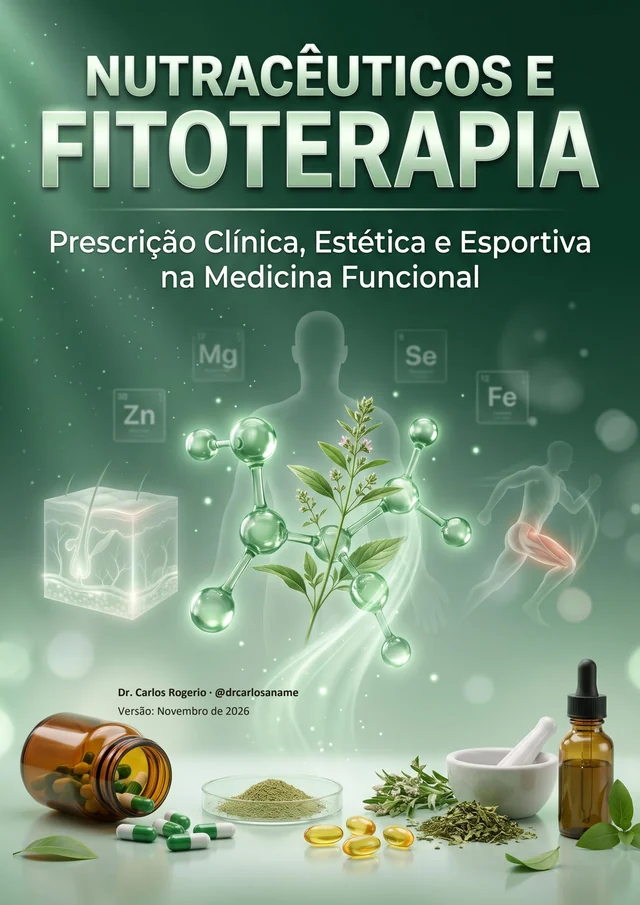
Cover of the e-book Nutraceuticals and Phytotherapy: clinical, aesthetic and sports prescribing in functional medicine.Coming soon

PDF e-book · 102 pages · Dr. Carlos Rogerio

Nutraceuticals and
Phytotherapy

"I already took it and it didn't work." A significant share of failures does not come from the active ingredient: it comes from an unsuitable product, a dose below the therapeutic range or too short a period of use. This e-book delivers what decides the result: 81 monographs with dose, form, standardization and interactions, 72 compounded formulas and the protocols by clinical indication.

  • 81 monographs: mechanism, dose, how to use, interactions and evidence
  • 72 compounded formulas, with the glossary of raw materials
  • Protocols: obesity, thyroid, sleep, libido, skin, joints and more

The English edition is coming soon

Tap "Notify me" and send the ready-made WhatsApp message: we will let you know when the English edition is out.
Intended for health professionals. Patients and the general public can also buy it.

What almost no one tells you
about supplements and phytotherapy.

At the pharmacy, on social media and even in the clinic, supplements are often chosen by the name on the label and the promise on the package. These are six points the e-book takes apart, each with the source for what is claimed and the module where the topic is covered in detail.

  • 01Module 21

    "If it's natural, it can't hurt"

    It can. Plants and concentrated nutrients have a real pharmacological effect. Ginkgo, turmeric and omega-3 at high doses increase the risk of bleeding with anticoagulants; 5-HTP and saffron with antidepressants can cause serotonin syndrome; and concentrated green tea extract, at 800 mg/day or more of EGCG, especially on an empty stomach, is on the liver injury list. The e-book brings together interactions, the liver and pregnancy in quick-reference tables.

  • 02Module 1

    "Supplements are all the same, only the brand changes"

    They are not. The same name on the package can hide completely different products: ephedra supplements have been found with an actual content very different from the label, Tribulus preparations contaminated with anabolic steroids and Ginkgo biloba extracts that failed identity testing. The result depends on the species, the part of the plant, the extract studied, the standardization and the chemical form: magnesium bisglycinate does not behave like magnesium oxide. Each monograph says what to check.

  • 03Modules 2 and 3

    "The more antioxidants, the better"

    Not so. Isolated beta-carotene in smokers and high-dose synthetic vitamin E showed no benefit or an increased risk: in the SELECT study, 400 IU/day of synthetic alpha-tocopherol was associated with more prostate cancer in healthy men. The e-book follows a different logic: ensuring the cofactors of the antioxidant enzymes (selenium, zinc, copper, manganese, magnesium) and the Nrf2 activators.

  • 04Module 7

    "Tribulus raises testosterone"

    A systematic review concluded that it does not, in humans. Methoxyisoflavone, ecdysteroids and GH secretagogues follow the same line: sold for mass gain, with no consistent increase in testosterone, muscle mass or strength in trials. Meanwhile, creatine monohydrate, 3 to 5 g/day, is the most effective and safe ergogenic supplement available, according to the position of the International Society of Sports Nutrition.

  • 05Modules 5 and 12

    "A good formula is one with lots of active ingredients"

    Two or three well-chosen active ingredients, at an adequate dose, usually outperform formulas with dozens of components at token doses. In metabolic phytotherapy, combining complementary mechanisms (absorption, insulin sensitivity, inflammation and microbiota) is worth more than raising the dose of a single active ingredient. The e-book organizes the choice by each patient's dominant axis: in obesity, there are eight axes of intervention.

  • 06Modules 8 and 18

    "Hair loss is solved with a hair formula"

    Before any nutricosmetic, the e-book calls for measuring ferritin, vitamin D, zinc and TSH and, in women, assessing signs of hyperandrogenism: correcting low ferritin usually has more impact than any hair formula. And biotin has proven benefit only in people with a deficiency, and it also distorts test results such as TSH, free T4 and troponin.

The e-book is not a menu for self-medication. The choice of active ingredient, dose and duration of use depends on individual assessment, lab tests and current medications, and is the responsibility of a licensed professional, within the rules of their professional board. What it delivers is the complete reasoning, from the pathophysiological axis to the active ingredient, with the level of evidence for each one in plain view.

From monograph to protocol,
with the limits of each active ingredient.

The foundations open the e-book: regulation, quality and the molecular axes that explain why active ingredients as different as turmeric, resveratrol, omega-3 and berberine converge on similar effects. Then come the three parts for day-to-day reference.

Clinical pearl

Minerals compete with one another for absorption. Iron, calcium, zinc and magnesium in high doses at the same time reduce each other's absorption and that of medications such as levothyroxine and antibiotics. Spreading the minerals across different times of day usually improves the result more than increasing the dose.

How the boxes appear in the e-book (module 3)
01
Part 2 · modules 3 to 11

Monographs: 81 active ingredients, all in the same template

What it is, mechanism of action, indications, usual adult dose, how to use, contraindications and interactions and the level of evidence, monograph by monograph.

  • Functional vitamins and minerals: D3 with K2, active B complex, magnesium, zinc, selenium, iodine and the limits of each one
  • Omega-3, coenzyme Q10, NAC, carotenoids and polyphenols, with what the major trials showed, such as REDUCE-IT, AREDS2 and Q-SYMBIO
  • Anti-inflammatory, metabolic and hepatoprotective herbal medicines, adaptogens and the herbs for mood, sleep and cognition
  • Sports nutraceuticals, nutricosmetics for skin, hair and nails and the active ingredients for joint health
  • Probiotics by strain and indication, and the herbs and classical formulas of Traditional Chinese Medicine

02
Part 3 · modules 12 to 20

Protocols by indication and the Formulary with 72 formulas

Integrated strategies for the most common conditions in functional practice, with active ingredient, dose and precautions side by side.

  • Obesity and binge eating through the eight axes of intervention, with a sample integrated protocol
  • Dyslipidemia, hypertension, homocysteine, insulin resistance and type 2 diabetes
  • Thyroid, anxiety, depression (adjunctive), sleep, cognition, migraine and peripheral neuropathy
  • Sexual health and fertility, skin aging, hair loss, cellulite, osteoarthritis and longevity
  • 72 compounded formulas by area, with dose and dosing schedule, and the glossary of branded raw materials
03
Part 4 · modules 21 to 23

Safety: what not to combine and how far to go

Interactions, the liver, pregnancy and the limits that separate a therapeutic dose from excess.

  • Interactions with anticoagulants, antidiabetics, antidepressants, levothyroxine, statins, immunosuppressants and others, with the course of action for each one
  • The active ingredients with relevant reports of liver injury and the signs that call for stopping right away
  • What is generally indicated, what to avoid and where data are lacking in pregnancy and breastfeeding
  • The upper intake levels of 15 nutrients, according to the IOM and EFSA, and what excess causes
  • Quality, labeling and anti-doping, and frequently asked questions from patients and professionals

102 pages in four parts.

From foundations to safety: the concepts and molecular mechanisms, the monographs of the active ingredients, the protocols by indication with the Formulary and, at the end, interactions, special populations, limits, frequently asked questions and references. Every monograph carries its evidence label.

Part 1

Foundations

Concepts, regulation, quality and the molecular mechanisms that guide prescribing.

  1. Mod. 1Fundamentals of clinical nutraceuticals
  2. Mod. 2Core molecular mechanisms

Evidence labels · Table 1

[MA]
Meta-analysis or systematic review of clinical trials
[ECR]
Published randomized controlled trial
[EC]
Smaller, open-label or observational clinical study
[PC]
Preclinical evidence (cell or animal studies)
[TU]
Documented tradition of use in traditional medical systems

Part 2

Monographs of the Active Ingredients

Vitamins, minerals, antioxidants, herbal medicines, adaptogens, sports nutraceuticals, nutricosmetics, probiotics and the herbs of Traditional Chinese Medicine.

  1. Mod. 3Functional vitamins and minerals
  2. Mod. 4Fatty acids, antioxidants and mitochondrial nutrients
  3. Mod. 5Anti-inflammatory, metabolic and hepatoprotective herbal medicines
  4. Mod. 6Adaptogens and phytotherapy for the nervous system
  5. Mod. 7Sports nutraceuticals
  6. Mod. 8Nutricosmetics: skin, hair and nails
  7. Mod. 9Joint health
  8. Mod. 10Microbiota: probiotics, prebiotics and synbiotics
  9. Mod. 11Traditional Chinese Medicine herbs with scientific support

Part 3

Protocols by Clinical Indication

Integrated strategies for the most common conditions in functional practice and the Formulary with 72 formulas.

  1. Mod. 12Obesity, binge eating and metabolic syndrome
  2. Mod. 13Cardiovascular health: dyslipidemia, hypertension and homocysteine
  3. Mod. 14Insulin resistance and type 2 diabetes
  4. Mod. 15Thyroid
  5. Mod. 16Mental and neurological health: anxiety, depression, sleep, cognition and pain
  6. Mod. 17Sexual health, libido and fertility
  7. Mod. 18Aesthetic and joint protocols
  8. Mod. 19Healthy aging and longevity
  9. Mod. 20Nutraceutical and herbal formulary

Part 4

Safety and Clinical Practice

Interactions, contraindications, special populations, safety limits, frequently asked questions and references.

  1. Mod. 21Safety: interactions, contraindications and special populations
  2. Mod. 22Frequently asked questions
  3. Mod. 23Scientific references

Written for those who prescribe and for those who take them.

The e-book is intended for health professionals, but patients and the general public can also buy it. The professional finds standardized monographs, levels of evidence, protocols by indication and safety tables; the patient finds, throughout the text, the "For the patient" boxes, with explanations in plain language, and arrives at the appointment knowing what to ask.

Health professionals

In functional and integrative medicine, within the scope of their legal competencies, who prescribe or advise on nutraceuticals and herbal medicines in clinical practice, aesthetics and sports.

  • 81 monographs in the same template, with the extract standardization, the usual dose, the interactions and the level of evidence
  • Protocols by indication and 72 formulas with dosing schedules, as a starting point for individualizing
  • The raw materials by the name used to order them from the compounding pharmacy, with a glossary of their composition
  • The tables on interactions, hepatotoxicity, pregnancy and breastfeeding and upper intake levels

Patients and the general public

Who use or are considering using supplements and herbs and want to understand what they take, before starting or during treatment.

  • The 16 "For the patient" boxes, in plain language, throughout the e-book
  • Why "natural" does not mean "free of side effects" and which combinations call for caution
  • How long each type of supplement takes to work and which tests to have before starting
  • The most common questions from people who use supplements, answered in Module 22

Intended for health professionals. For patients and the general public, the e-book is a way to understand the use of nutraceuticals and herbal medicines: it is not a prescription, it does not replace a consultation with a licensed professional, and formulas and doses should not be used on your own.

The complete e-book
coming soon in English.

The English edition is in preparation. Leave your request and we will message you on WhatsApp when it launches.

Cover of the e-book Nutraceuticals and Phytotherapy: clinical, aesthetic and sports prescribing in functional medicine.Coming soon

AuthorDr. Carlos Rogerio@drcarlosanameNovember 2026 edition

What you get
  • 102-page PDF e-book with 23 modules in 4 parts
  • 81 monographs: what it is, mechanism, indications, dose, how to use, contraindications and evidence
  • Protocols by indication: obesity, heart and blood vessels, diabetes, thyroid, mental health, sexual health, aesthetics and longevity
  • Formulary with 72 compounded formulas and the glossary of branded raw materials
  • Probiotics by strain and the herbs and classical formulas of Traditional Chinese Medicine

  • Safety: interactions, hepatotoxicity, pregnancy and breastfeeding, intake limits and anti-doping
  • 34 tables, 9 figures, frequently asked questions and 41 scientific references
PDF pages
102
monographs
81
compounded formulas
72
tables
34
scientific references
41

Every monograph carries its level of evidence ([MA] [ECR] [EC] [PC] [TU]), from meta-analysis to traditional use, and the doses match the ranges described in clinical studies and in integrative practice for adults.

The English edition is coming soon

Tap "Notify me" and send the ready-made WhatsApp message: we will let you know when the English edition is out.

Frequently asked
questions

If yours is not here, write to contato@basefuncional.com.

Dr. Carlos
Founder and CEO

Dr. Carlos

@drcarlosaname

Biomedical scientist, specialist in functional medicine and nutrition.

With a postgraduate degree in Aesthetic Biomedicine, he furthered his studies in Nutritional Adequacy and Maintenance of Endocrine Homeostasis: Prevention and Treatment of Age-Related Diseases, by Dr. Lair Ribeiro.

He starts from functional physiology and biochemistry to understand each patient. In metabolic health, he reads epigenetics and metabolism to reach the origin of the imbalance. In aesthetic biomedicine, he treats beauty as a reflection of health. In bio-oxidative and regenerative therapies, he works with the body's own capacity to regenerate. In everything, the same principle: investigate the cause before treating the symptom.

At Base Funcional, he brings together in one place the apps, courses and e-books that take functional medicine from investigating the cause to the daily routine of the practice.

The right product, dose and duration,
and the safety of each active ingredient in plain view.

Notify me

102 pages, 81 monographs and 72 formulas, coming soon in English.